DIGITALIZR Edge Themes

The Digital Operating System for Multi-Carrier Ports

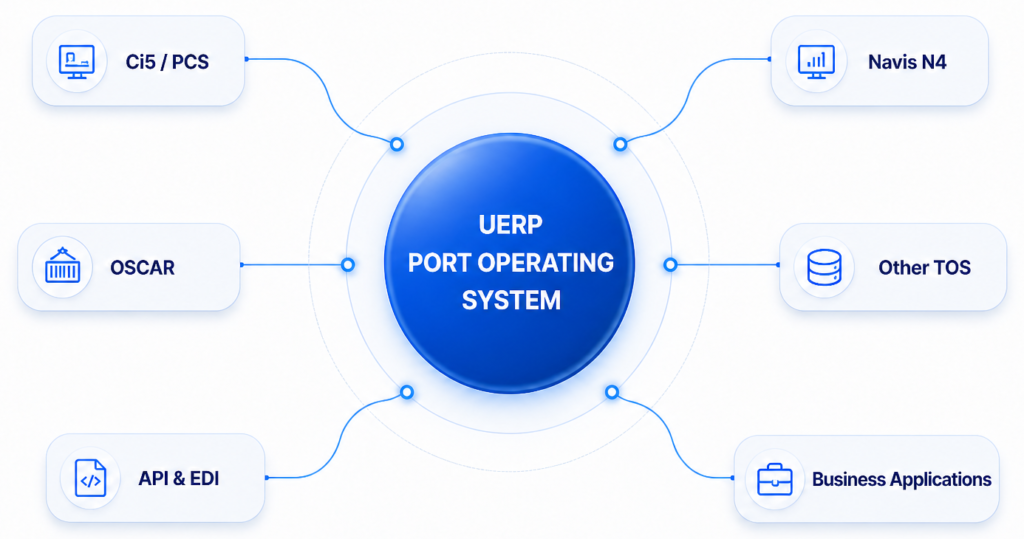
UERP enables port authorities, public port agencies, and port operators to digitize, track, and orchestrate their own processes, while remaining interoperable with Ci5, Navis N4, OSCAR, and the TOS systems already in use by operators.

Specialized systems continue to perform their operational functions. UERP provides port managers with their own platform for monitoring, billing, and management.
A POS THAT COMPLEMENTS EXISTING TOS

Multiple operators, multiple systems, a single control layer

A port brings together many stakeholders: the port authority, terminals, cargo handlers, shipping lines, agents, customs officials, freight forwarders, logistics providers, and technical teams.

Each can use its own applications. The challenge, therefore, is not to systematically replace these tools, but to facilitate the flow of information, consolidate relevant events, and provide the port manager with an independent overview of port operations.

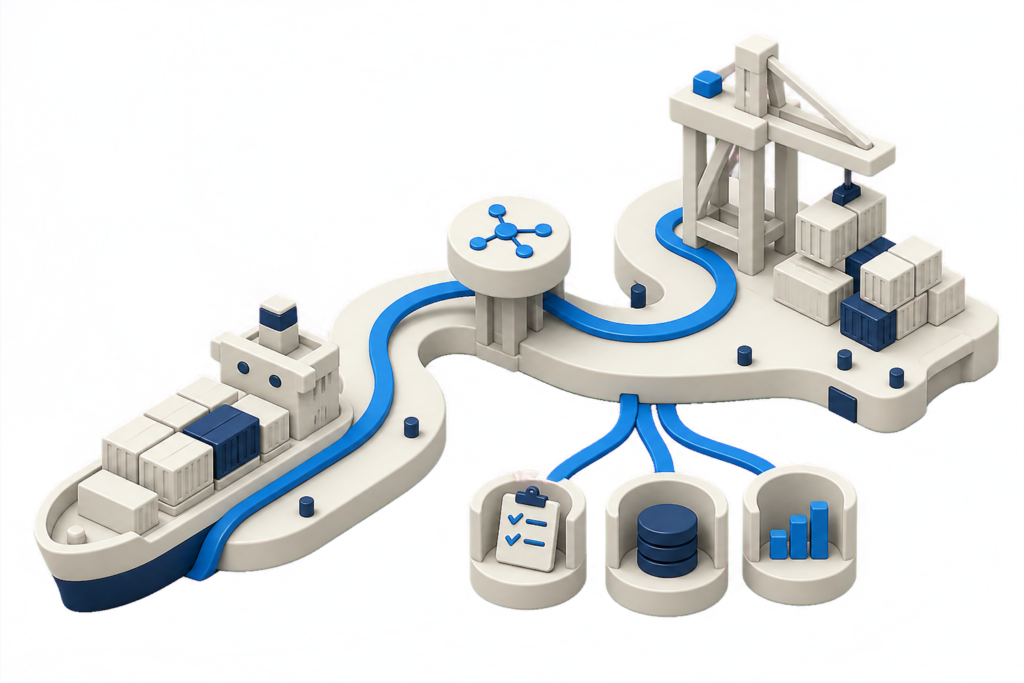
The UERP Port Operating System serves as this common layer for management and orchestration.

TOS Operators

+

PCS / Ci5

+

UERP POS

A coherent, interoperable, and scalable port architecture.

The TOS retain their role

They continue to oversee specialized operations at the terminals and among the cargo handlers.

The port retains its reference system

The manager has full control over their data, rules, contracts, and processes.

UERP connects everything

The platform links operational events to controls, workflows, and financial consequences.

FROM THE STOPOVER TO CHECK-IN

Consistency between transactions, their supporting documents,
and their financial value

UERP allows users to model and link the main objects in a port environment.

01 - Operations

Ships & Ports of Call

Shipping lines, port calls, containers, shipments, reefers, and IMDG shipments.

02 - ACTORS

Carriers & Third Parties

Warehouse workers, customers, agents, suppliers, and partners.

03 - HERITAGE

Facilities & Infrastructure

Cranes, docks, buildings, machinery, and technical facilities.

04 - REVENUE

Services & Contracts

Rates, fee schedules, use of public land, invoices, and accounting entries.

TRACEABILITY AND AUTOMATION

From on-site assessments to automated billing

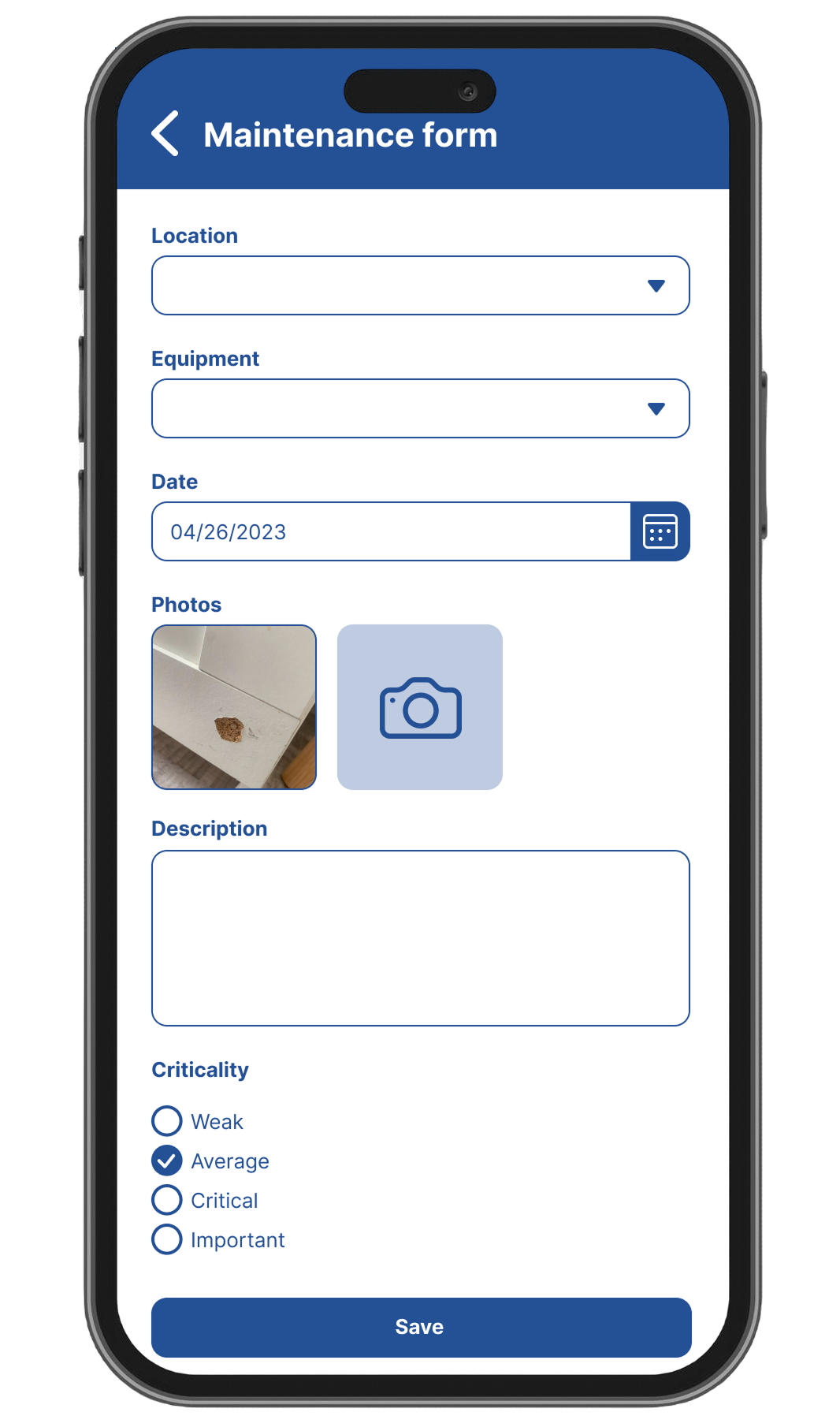
A transaction recorded on a smartphone can be linked to the vessel, the port of call, the container, the operator, the service provided, the applicable contract, and the corresponding rate.

1

Field Operation

Recording of the event and related evidence.

2

Traceability

Attachment to the ship, port of call, container, or equipment.

3

Control

Reconciliation of observed and reported events.

4

Validation

Implementation of workflows and responsibilities.

5

Pricing

Identification of the applicable contract, rate schedule, or rule.

6

Billing

Gradual creation of billable items.

THE PORT DIRECTLY ON YOUR SMARTPHONE

The field becomes a structured source of data

The teams prepare and document unloading reports, reefer and IMDG inspections, crane movements, gate crossings, inspections, and service calls at the sites where operations take place.

AN OPERATIONAL AND MANAGEMENT PLATFORM

Manage activities that fall outside the scope of the TOS

Port Billing

Manage services related to port calls, vessels, containers, equipment, and completed operations. Apply the corresponding rates, schedules, and contractual rules.

Public Land Management

Organize tenants, lots, buildings, areas, agreements, AOTs, rents, fees, indexations, pro-rata allocations, and adjustments.

Electronic Billing

Integrate the applicable data feeds, including Chorus Pro and Factur-X, according to the relevant processes.

Infrastructure and Maintenance

Track equipment, documents, inspections, service calls, costs, availability, and maintenance requirements.

Teams and HRIS

Link operational needs, assignments, schedules, skills, training, authorizations, and employee documents.

Reporting and Monitoring

Consolidate events, operational metrics, financial data, and validation history.

AN ARCHITECTURE DESIGNED FOR MULTIPLE TOS

The port system must not depend on a specific operator's technology

UERP can integrate with Ci5, Navis N4, and OSCAR environments, as well as with other TOS, PCS, APIs, EDI feeds, and business applications.

Relevant information is received, structured, and reconciled against the UERP repository before being fed into the control, billing, and management processes.

This allows the manager to retain their own data model and operational flexibility, even as operators or their technologies evolve.

LOW-CODE ET CODAGE MANUEL

Adapt to each port without compromising the base

Low-code for Business Processes

Quickly configure objects, forms, screens, rules, workflows, controls, and web or smartphone applications tailored to port operations.

Human-coded for the software core

The foundation remains under control, maintained, and auditable to ensure the robustness of the data, rules, and integrations.

Composable in Deployment

Gradually activate priority processes without waiting for the information system to be fully rebuilt.

Unified in
architecture

The new applications share the same data, security rules, and orchestration mechanisms.

UERP PORT OPERATING SYSTEM

Take back control of your port operations

A port may have multiple operators and multiple TOSs. It must, however, maintain its own management, control, and oversight system.

We can start with a priority process, quickly build a proof-of-concept, and then gradually expand the platform without disrupting the architecture.

A French and sovereign solution

Secure hosting in France

Compliant with the GDPR and industry standards

Local Support and Expertise